
A Hint on Hockey Development
World series results

The Toronto Blue Jays hitters have had a great post-season. One stat tells part of the story: the Jays’ returning hitters have improved their average bat speed more than most teams.
The well-known baseball development company Driveline posted about how Jays’ hitting coach David Popkins approached the task. Popkins is credited with helping the hitters make large improvements to their average bat speed. The Jays were well below average in this category the previous season and now approach average.
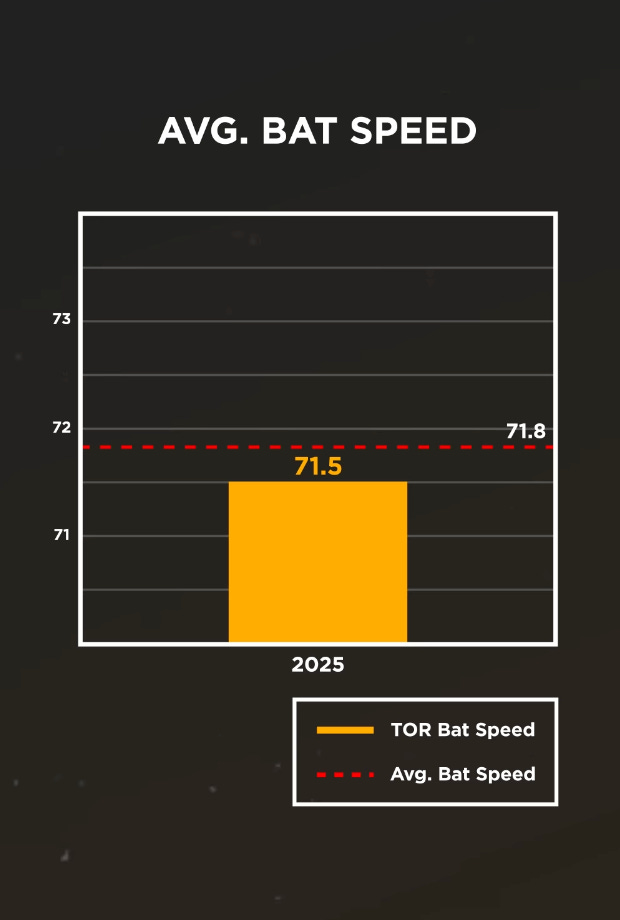
I’m thinking about what this story means for hockey development. Specifically, how could I find something simple for my players to improve that will have outsized results? Average bat speed is an elegant stat. It seems to have a lot of signal to the team’s success. Maybe there is something like this for hockey.
The way I see it, increasing bat speed is like improving any ability that is essential to success. Can’t move the bat fast enough? You won’t hit many baseballs hard. In hockey, if you can’t skate to a loose puck fast enough you won’t win many pucks back for your team. This is one example.1
In hockey, the variations of each situation and lack of accessible tech at youth/junior levels make it harder to get clean stats like ‘average speed to loose pucks.’ If you could measure this, it would be simple to explain to players how important training your speed is.
Regardless, we can assume it is important. I would say hockey has done a reasonable job training players to be fast to loose pucks. Every junior scout and coach can tell you which players have a good ‘first three strides’. Everyone in hockey knows foot speed is important. I’m curious how well coaches help their athletes improve it.
How would you train speed to loose pucks even better? Two principles come to mind:
Physical training: the body needs to adapt to move fast in general-- if a player can do this better than others, it’s an advantage.
Hockey specific: a hockey player needs technical abilities to pair with their physical abilities. Skating is highly technical and the best players get the most speed for what their body can produce.2
If you wanted to measure speed to loose pucks for an individual player you might:
Clip video of all their puck races.
Measure the distance skated from the moment they accelerate to the moment they get to the puck.
Divide that by the time they take to get there (from acceleration to arrival).
Take each race you now have a speed for and calculate an average.
Track that average over the season.
The purpose of this exercise would be to frame the player’s abilities today as something tangible to improve. Now you could get to work on solving it.3
This story reminds coaches of an opportunity: focus on something tangible and high leverage to improving a player’s game. I think there are ways for hockey coaches to use this framework. In fact, there are many possibilities.
The typical adage of the three speeds (head, feet, hands) doesn’t specify all the ways good players are faster than their opponents. Here is a more specific list: your stick speed to make shots and passes in small amounts of time at the velocity needed; your hand speed to control pucks coming at you at high velocity; your speed to recognize a situation and act accordingly (aka ‘soft skills’, a vague term borrowed from Daniel Coyle, where one example might be recognizing a defender who can’t block a pass because he isn’t in a posture to defend.); your speed of your stick checking; your speed to close distance on a check; your accuracy of your stick checking.
Players need the knowledge of where to position themselves but this opens up a can of worms because teams play different systems; a good prospect or player will be recruited/signed because they have the two elements above.
Maybe this player always turns the wrong way, falls down too often, isn’t explosive, can’t turn on their skates to race in a straight line, or anything else players tend to struggle with. Maybe they are overtrained and cannot race like they did earlier that year. There’s more… perhaps they tend to decide to race too late, effectively making the time to race to the loose puck longer. In hockey, like in baseball, speed is not absolute and without context. Hitters have to decide when to swing (and use their bat speed). Hockey players need to use the speed they train well, including knowing when and where to go.